Tags
Aaron Paquette, Action Lab, Bible studies, blogs, Cities Reducing Poverty, CSI, Davenport Perth Community Ministry, Edmonton, FaceBook, Gospel of Luke, Grandin Station, hitchhiking, LRT, Murals, poverty, Reconciliation, residential schools, single mothers, skills, social assistance, Social Innovation, Social Media, white buffalo
I was privileged to be able to attend “Cities Reducing Poverty: When Mayors Lead” that took place in Edmonton, Alberta on April 5-7, 2016.
The City of Edmonton and the End Poverty Edmonton team led the events for an afternoon where we were invited to engage with and learn from the people and organizations that are working in new and exciting ways to address poverty’s complex challenges in Edmonton. There were eight Innovation-in-Action experiences from which to make my selection. I wanted to explore the Edmonton LRT and so signed up for Group 7: Grandin and Stanley Milner Library (LRT only). Unfortunately, I was only one of two others who signed up so was reassigned to Group 2: Action Lab and Grandin Station.
The Action Lab, http://www.skillssociety.ca/action-lab/ is a social enterprise of Skills Society – a leader in social innovation and one of the largest disability service organizations in Edmonton. With help from Manasc Isaac Architects the space was designed for hosting inspiring events, group collaboration, strategy sessions and social innovation. There isn’t anything quite like the Action Lab in western Canada. The Action Lab experience promotes creative problem solving, offers tools to help tap into collective wisdom and helps people prototype solutions to challenges they are working on.
Revenue from the Action Lab supports the employment of people with disabilities, innovative social change initiatives of Skills Society and subsidizes community groups who can’t afford the full fee. In Toronto, we have some similarity to this with our own CSIs, or Centre for Social Innovation, http://socialinnovation.ca/, with launch pads at CSI Spadina, CSI Annex, CSI Regent Park and and the exported CSI Starrett-Lehigh (Manhattan, NYC).
Then we went to Grandin Station. When I was in Edmonton 35 years ago, I remembered that the LRT was just starting and had only two stations. At the time I was on my summer internship and had no car to respond to distress calls that came in the middle of the night so I hitchhiked and took rides from trucks with wheels that were taller than me. At the time, I did not understand the questions the drivers asked, “Are you a squaw? Will you be my moose tonight?”
But I talked to drivers about what I was doing, where I was going and heard their stories in return. They came to the church where I was the student intern, attended services, and even joined in on Bible Studies, at that time, the Gospel stories in Luke. Some of them also joined in a campaign to change an offensive application form for assistance to single mothers.
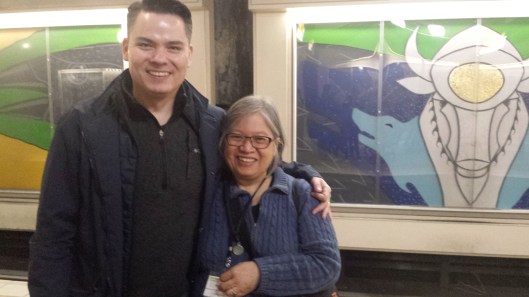
At Grandin Station, I saw the artist whose work was being featured in the mural there. I met Aaron Paquette through Face Book, but never before in person. In social media, we exchanged some ideas about art and spirituality but I had no idea that he was going to be in Edmonton, and in the conference that I happened to be participating in.
Aaron, looked at me, held my hands, called my name and gave me a big hug!
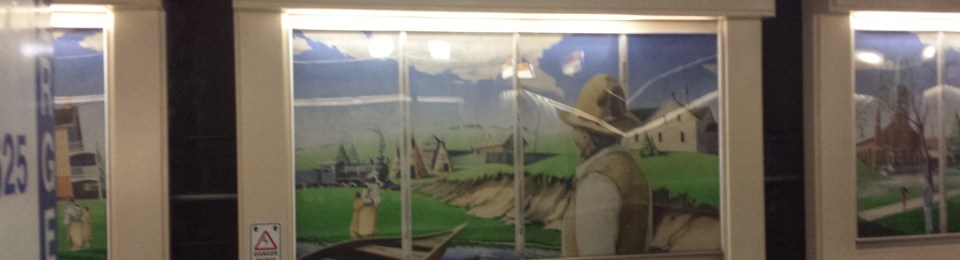
Aaron explained to us The Stations of Reconciliation. Instead of me retelling what he said, I will put a link to the blog that he wrote of it: http://www.aaronpaquette.net/?p=4778 27. Years ago, artist Sylvie Nadeau was commissioned to create an artwork as a tribute to Vital Grandin, the first Roman Catholic bishop of St. Albert. The original mural, showing Grandin standing alongside a nun who is holding an aboriginal child was considered hurtful to First Nations people in Edmonton in light of the abuse and cultural assimilation that took place in church-run residential schools. The painting seemed to glorify an era of pain, a philosophy of genocide.
Some people were offended by the mural on the west wall and wanted it erased, white-washed. Aaron wrote on his blog, “Since when has forgetting our history been a good idea? We need it to remind us, to help teach our children. School groups can come down to see these murals and learn the whole story, they can learn the context, and can come to their own insights, their own conclusions. I personally asked that this original mural remain. I loved it as a child. It was one of the few things in the city that acknowledged that my ancestors walked these hills, loved these waters. My understanding of the images changed as I grew and we all grew.”
“I chose to follow a healing path, a path that didn’t see history or humanity as an isolated thing, but as part of a long arc of time, a small part of the web of life. I spoke with Elders, with survivors, with youth and with people from the community. I asked them their opinions, I asked for their stories, their hopes, their dreams. I asked them for their solutions.”
From Aaron’s blog, “The centre of the mural, the part I knew was so important and essential, was the White Buffalo. The White Buffalo is considered a sacred animal and it represents many things for many people, most of all it represents peace, renewal and hope. It symbolizes the dawn of a new era, of true knowledge, wisdom and education. Flanking the White Buffalo are two wolves. They represent our close connection to the land, they remind us we are all family and we are all connected. While they walk alone from time to time, they also run together.
The bears surround the wolves and the buffalo. They are the protectors. They are health and healing. They are filled with starlight and power.” The reflection of the bull on the west wall was reconciling, because over the image of the residential school the reflected image of the white buffalo appears.
It was a real blessing for me to come full circle and return to Edmonton and meet a friend who painted and spoke about reconciliation. Chi-miigwetch and Salaam!
 DP Community Minister's Blog